Forty years painting the truth about women — knowing, complicated, funny, and quietly on fire with wanting things.
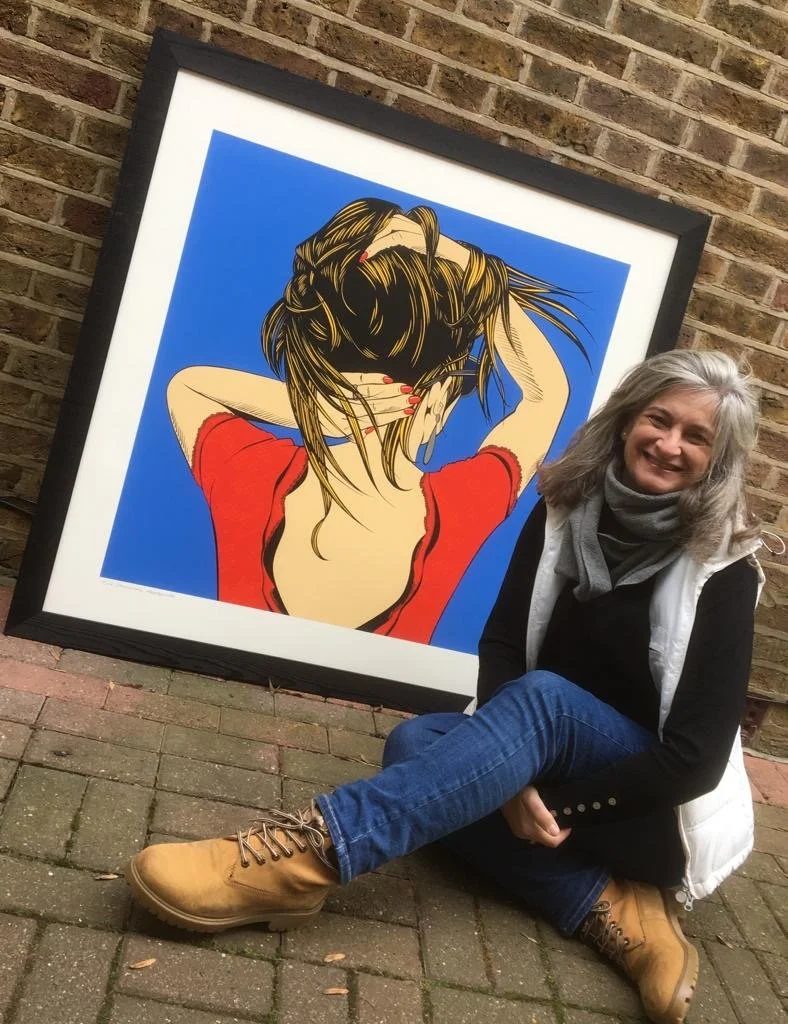
There is always a woman in the room who knows exactly what is happening. She is composed, immaculate, and quietly on fire with something she has no intention of sharing. Deborah Azzopardi has been painting that look and those feelings for over forty years. And for forty years, collectors have been living with them on their walls.
Azzopardi came to fine art through desire. The desire to paint with imagination and creativity, ideas, her own subjects, she had her own style. Early in her successful painting career, she worked with Disney and brands including Bovril and Bisto to something more urgent and more personal, painting everything that interested her: women, men, fruit, objects, secrets, imagination. The subjects were multiple. The theme was always one. The work that followed has appeared at Christie’s, Bonhams and Art Miami and can be counted in the collections of global pop stars, actresses, sport team owners and recognisable names in contemporary celebrity. Her painting Sshh… has become one of the most reproduced images in global popular culture.
“What I found interesting, what I have always found interesting, is women. Specifically: what women want. What wanting feels like. The thrill of it. The joy. The vulnerability. The ridiculousness. And occasionally, the pain.”
The visual language Azzopardi developed is unmistakably her own. Strong, defining lines. Bright, saturated colour. Red lipstick. A smile. Lashings of fun. At first glance it is a pleasure. Vibrant, witty and immediately seductive. And that is precisely the point. Influenced by the painterly style fashion and lifestyle illustrators René Gruau and Toulouse-Lautrec, her compositions take cues from Lichtenstein, Pop Art and the graphic confidence of the 1960s. But they focus on the subject that male artists largely left alone and did not understand, female desire. Art critic Estelle Lovatt put it plainly: America has Lichtenstein, we have Azzopardi. The comparison is instructive, and so is the difference. Lichtenstein’s women are wide-eyed, tearful, waiting. They are objects of the gaze, pinned to the canvas by it, whereas Azzopardi’s women are doing the looking. They are the ones who decide what happens next. Galleries, in the early years, were afraid about what to do with paintings about female desire and women clearly enjoying themselves. This, Azzopardi decided, was their problem. Like her, they needed to be brave.
Wrapped inside the pleasure of the artworks is the truth about female desire. The thrill of wanting, the joy, the vulnerability, the ridiculousness, and the pain. The things desire makes women do. The lines it has made them cross. She just made sure it was beautiful enough that you might not notice immediately. And then you do.
In 2016, Mitch and Janis Winehouse commissioned her to paint Amy, a commission that made perfect sense. Amy Winehouse understood the performance of desire - the thrill of it, the vulnerability and the things it made her do. She was an Azzopardi subject made real.
There is a question that runs beneath all of it. Are women the objects of desire, or have they always been its architects? Her answer, painting by painting, is consistent: always the architects. And that private, certain knowledge held close, performed lightly, occasionally weaponised and occasionally surrendered is what makes female desire the most interesting thing in any room it enters. To own one of these paintings is to choose which woman you want looking back at you from your wall. That, it turns out, is not a small decision. It is the most personal thing a room can contain.
Collecting Azzopardi has always been, for the women who do it, less about acquisition than recognition, the particular satisfaction of finding a painting that already knows something about you. She shows no sign of stopping.